One of the hardest things I’ve been learning to do the past couple of years, is to learn how to let go of good things. In many ways, I feel that choosing between good things can almost make me wish that I didn’t have that many options in the first place and only have one choice.
And this is something that I’ve thought about a lot recently. For some context, I never really had to choose between good things seriously until this year. For the first time in my life, I’m making decisions that are short term committing. I’m also reckoning with the question of what do I want to do in life and what type of career is right for me. Do I want to continue to pursue a path in quant, or should I give up an offer from Jane Street and pursue something else I’m passionate in, like startups.
Optionality
I think a lot of it stems from the idea of optionality. Optionality is roughly the idea of the amount of options that you have. A lot of life can be understood through the lens of maximizing optionality. People say to go to a good school because it will provide more options down the line. Get good grades because that will help you get into a good college which will them provide more options. Join clubs because they will allow you’ll have more job opportunities down the line. Things are done because they either maximize optionality, or lead to things that will maximizing optionality.
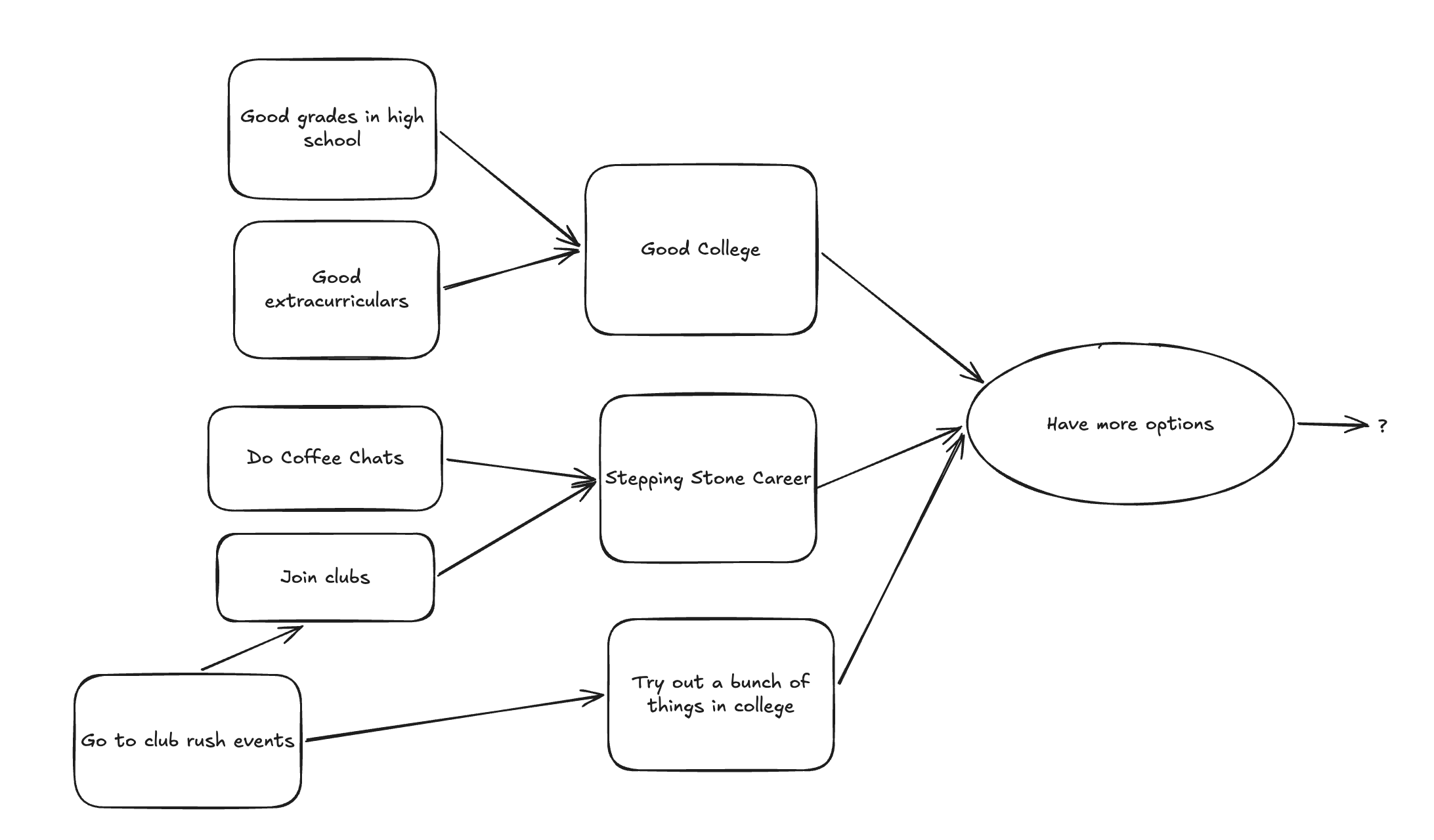
I think for most who were from an academically rigorous environment can relate to that experience. A lot of things are done for this generic black box of “maximizing options”.
I think I only started realizing this when during my freshman year, a friend had shared a Harvard thought piece on optionality and also how it was can be a trap. Now I don’t think that maximizing optionality is inherently wrong, but I do think that ending the pursuit at optionality is wrong. Optionality is good in so far as it serves a purpose. Options are beneficial if you have some internal metric to choose between them, but I think all too often its seen as the end goal itself. IE people value having options because having more options is better than having less (which is fair), and then choose to focus on maximizing the number of options they have available to them.
I do really think the Harvard piece is a really good read and helps to answer why we also choose to perhaps focus too much on focusing too much on holding onto a lot of options. In essence, options expose you to the benefit of a decision without the downside of the decision. Having the option to join the company is nice because if the company succeeds, you can join and be part of a unicorn. If the company goes down, well you can choose to not exercise that option and not be part of a sinking ship.
Lost Pursuit
So I think it’s very natural for us as risk averse individuals to focus on maximizing optionality. We get the benefit without exposing ourselves to the potential harms. But in that exercise, where the goal is to maximize the number of options, I feel like it leads to a false pursuit; where the goals being chased are no longer the ones that we originally started with.
Delaying Exploration
One thing I see a lot when I talk to my friends in banking, is the reason they’re going into investment banking is to stick in it for 2 years and then pivot out to a buy side role like venture capital, private equity etc. And while it might be necessary in some ways (in that like PE doesn’t recruit that many people out of undergrad), I can’t help but feel like theres a sense of delaying the end goal in favor of maximizing optionality.
More generally, I would imagine that most people have some set of beliefs about who they are as people and their goals in life. Lets for example say make it onto broadway. In my opinion, the way to understand if that goal is right for you is to run headfirst at it. As my friend Kevin Xu put it once, “attempt to (in)validate the null hypothesis”. If the end goal gets put behind other intermediary goals, I think its easy to get distracted from validating/invalidating beliefs about ourselves. For the person who wants to make it onto broadway, working at a stable job to maximize their income will not get them any closer to determining if broadway is what they want to do in life.
And so I can’t help but wonder, at what point is maximizing optionality by pursing things like banking delaying the ability to actually pursue your actual goals.
Learning To Make Hard Decisions
Perhaps tied to the original premise of this article, but maximizing optionality is by definition, avoiding making decisions. By choosing to focus on having a lot of options, it means not picking any single one to stick with. And the mentality of focusing on having more options is what makes it hard to make decisive decisions in the first place.
But life is about making decisions. Whether right or wrong in retrospect, the decisions that you’ve made have brought you to where you’re at in life now. Life is ultimately about making these decisions.
Big Schools and Opportunities
Ok. I’ve spent a long time now talking about the downsides of optionality, but I also want to give it a fair credence. I think the problems with optionality are first world of first world. One can only complain about optionality once they have a lot of options; a luxury in and of itself. And I recognize that the luxury of choice is not broadly applicable.
One of the things that I think that I learned early on at Michigan was that you had to fight for opportunities. Maybe not in a 1v1 brawl kind of sense, but also nobody is handing out freebies at a state school. For things like internship opportunities, events, clubs, they all take effort to apply to and get, and are also competitive by nature. And I think in that environment where I was getting rejection after rejection, I started to develop a mentality of saying yes to everything.
It was that mentality that pushed me to put myself out there a lot, and what ultimately allowed me to be in the position where I am now. I applied to Roblox my freshman year because they had some recruiting event on north campus on a Thursday evening. I had nothing better to do so I applied for fun. That random recruiting event was what convinced me to apply and what ultimately allowed me to get my freshman year internship. So when I talk to people going into college, I do think part of the advice is to say yes to everything, because you really won’t know what you’ll like until after you say yes to a lot of things. And the attitude of saying yes to a lot of things will get you towards success better than being uber selective about the things you say yes to.
I do think big schools do a really good job of teaching you that from the get go. And in many ways, I think it’s an important lesson. Optionality is something that you need to fight for. To have options in an environment where options are not given out necessitates some amount of effort to have been put in. I think in my life, putting that effort in is a prerequisite to later be able to have this more nuanced view towards optionality.
2 Paths in a Wood
I guess if there’s one main point I have, its that options are a means to an end, but not the end itself. It is not that having more options is good and thus maximizing the amount of options available should be the end goal, rather options are good in that they allow you to pick the best path forward to achieve your goals. But the pursuit of the options afford you matters; not the state of of having options itself.
And so thus one of the conclusions I’ve begun to draw, is that as I begin to have more and more options, what the next thing to work on is personal judgement. The evaluation criterion upon which I decide which choice I want to make. After all, options are only as good as you can properly analyze them and pick the best one.
With that I think to a poem that my brother shared with me once when I brought up this topic to him earlier in the year. “The Road Not Taken” by Robert Frost, describes a person sitting at the crossroads in the path, deciding which road to take. And despite both roads looking roughly the same, the narrator agonizes over which path to take.
Two roads diverged in a yellow wood,
And sorry I could not travel both
And be one traveler, long I stood
And looked down one as far as I could
To where it bent in the undergrowth;
Then took the other, as just as fair,
And having perhaps the better claim,
Because it was grassy and wanted wear;
Though as for that the passing there
Had worn them really about the same,
And both that morning equally lay
In leaves no step had trodden black.
Oh, I kept the first for another day!
Yet knowing how way leads on to way,
I doubted if I should ever come back.
I shall be telling this with a sigh
Somewhere ages and ages hence:
Two roads diverged in a wood, and I—
I took the one less traveled by,
And that has made all the difference.
Now I won’t do an actual literary analysis of the poem, although there’s plenty online for that. I do think that the meaning is one I really enjoy. That it doesn’t really matter which road you take. In many ways, all of the roads are roughly the same. And whether in retrospect, it looks like the path more traveled, or it was the more common path, it doesn’t really matter. If the path you take is the wrong path, you’ll eventually end up course correcting onto the right one.
Mulling over this, I do think it’s helped me get a sense of peace. That not every small decision I make has to be perfect. I might be giving up a theoretically “better” choice, but that’s part of life and something that should be accepted instead of avoided.
I think in a lot of things, the only wrong choice is to not make a decision. For me right now, that decision means picking and choosing to join a startup. That may then cause me to have realizations that down the line that will then make it so that I give up other opportunities, but I think that’s worthwhile towards pursuing my goals.
The Windy Path of Life
Very related was a realization I had recently, during ironically enough a coffee chat. Or perhaps more accurately, a saying that I captures how I feel pretty well;
“The shortest path is often not the correct path”
I think in a lot of ways, we conflate the correct path between points A and B as the shortest path. If point A is where I’m at right now and point B is some goal I have, like discovering what I want to do in life, it’s pretty easy to think that the shortest path, IE getting a job, doing leetcode etc is the correct one. But in a lot of cases, the windy path is the more useful one. A random sidequest that allows you to explore something you might be interested in can help you determine what the end goal is.
So for a lot of things, I think they’re more of directions than they are hard and fast goals. Like the north star in the night sky, or a half of a compass you want to travel towards. Even if the path I take isn’t the shortest distance between where I’m currently at and where I think my goals are, it is the correct path if it allows me to discover what my goals actually are.
Giving up Options
With all that said, I think thats why giving up a good thing is so hard. It means changing the mentality that I grew up with, the one that guided me through freshman year, accepting that maybe there will be less security, that things are less determinant, but doing all that because choosing to go with a good option is better than not choosing any option. Options aren’t the end goal, they’re the start to something else.